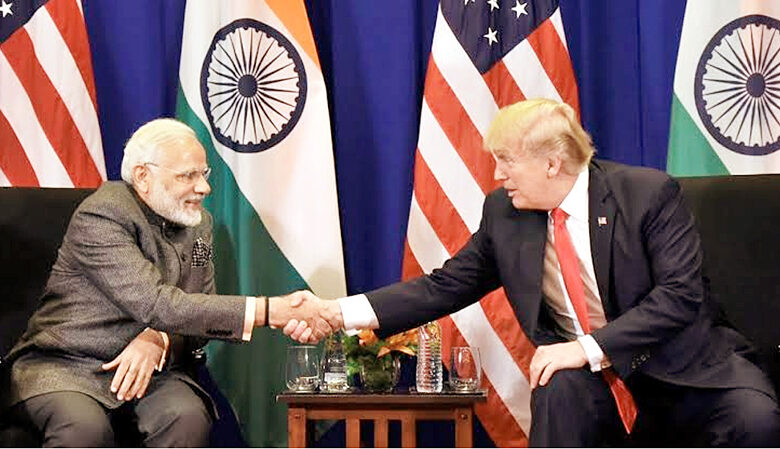
New Delhi: In international politics and global commerce, trade agreements are never merely about numbers or tariff percentages. They reflect a nation’s sovereignty, the firmness of its leadership, and the direction of its future. Seen in this light, the recent India–United States trade understanding—under which a proposed 50 per cent tariff has been reduced to 18 per cent—emerges as a significant and far-reaching development. Beyond offering economic relief, the decision underscores shifting global power equations and India’s enhanced bargaining capacity on the world stage.
The evolution of this agreement vindicates the adage “better late than wrong.” When the United States initially exerted pressure by proposing steep tariffs on Indian products, apprehensions were voiced that an emerging economy like India would eventually have to concede. Recent global trade history shows that major powers often rely on pressure tactics to safeguard their interests. However, the progression of negotiations—from their initiation in February 2025 to their constructive conclusion in February 2026—demonstrates that India neither rushed into a deal nor compromised its national interests. Instead, it assessed the situation patiently and secured a balanced, dignified outcome.

The immediate impact of the tariff reduction was visible in the business world and stock markets. Investor confidence improved, exporters received relief, and positive market signals emerged. Yet the deeper significance lies beyond short-term gains. The agreement confirms that India is no longer merely a rule-follower in global trade, but an active participant in shaping and redefining those rules. The United States softening its stance reflects India’s economic strength, strategic patience, and political confidence.
Prime Minister Narendra Modi’s foreign policy has consistently emphasized dialogue without submission. Whether in defence cooperation, energy security, or trade negotiations, India has advanced its interests without yielding to external pressure. In this deal too, India articulated its position firmly, compelling the US to revise its proposals. The outcome is not just a commercial success but an illustration of political maturity and resolute leadership.
The agreement is expected to enhance the global competitiveness of Indian industries. Lower tariffs will make Indian products more accessible in the US market, strengthening exports and giving fresh impetus to the “Make in India” initiative. Sectors such as textiles, pharmaceuticals, automobiles, agriculture-based products, and emerging technology industries are likely to benefit in the long run. India is steadily transitioning from being viewed as a source of cheap labour or raw materials to an economy driven by value addition and innovation.
Addressing a parliamentary party meeting, Prime Minister Modi described the agreement as the “result of sustained patience,” encapsulating his diplomatic approach. The deal was not the outcome of a sudden development, but of a year-long process involving strategic waiting, expansion of alternatives, and balanced engagement. Despite opposition criticism and immediate pressures, the government chose restraint, recognizing that haste in global trade and geopolitics often proves costly.
The US shift was driven not by sentiment but by strategic necessity. Over the past year, India demonstrated that it had viable alternatives—energy cooperation with Russia, a historic free trade agreement with the European Union, and an increasingly vital role in global supply chains. Prolonged unilateral pressure would have risked excluding American companies from one of the world’s fastest-growing large markets.

While dramatic demands and rhetoric dominated parts of the discourse, India refrained from public confrontation or hasty acceptance. This calm approach contrasted sharply with the opposition’s impatience, which focused on short-term gains and losses rather than the long-term nature of international trade negotiations. Today, with the US revising its position and India standing firmly in the front ranks of global competition, the wisdom of strategic patience is evident.
The episode also signals a broader shift in global trade—away from pressure-based politics towards balanced dialogue. For decades, large economies have used tariffs and restrictions to compel smaller or emerging nations to comply. India has challenged this trend, demonstrating that confidence, economic capacity, and political will can transform coercion into cooperation.
In the context of India–US relations, the agreement points to a new phase—one that transcends strategic and security cooperation to embrace deeper economic partnership. Its impact will resonate beyond the two nations, strengthening a multipolar global order where leadership is shared rather than concentrated.
The deal has also enhanced the Modi government’s international credibility, built not on rhetoric but on tangible results. India is increasingly perceived as a nation that protects its interests while contributing positively to global stability and cooperation. As India advances towards becoming the world’s third-largest economy, such agreements mark critical milestones on its journey.
Ultimately, this trade understanding reflects mature diplomacy and visionary leadership. In global politics, decisions are not merely economic calculations—they are affirmations of sovereignty, self-respect, and leadership strength. By choosing patience over haste, India has secured outcomes aligned with its national interests. Under Narendra Modi’s leadership, India moves forward with confidence, reinforcing its trajectory towards becoming a decisive global power.